
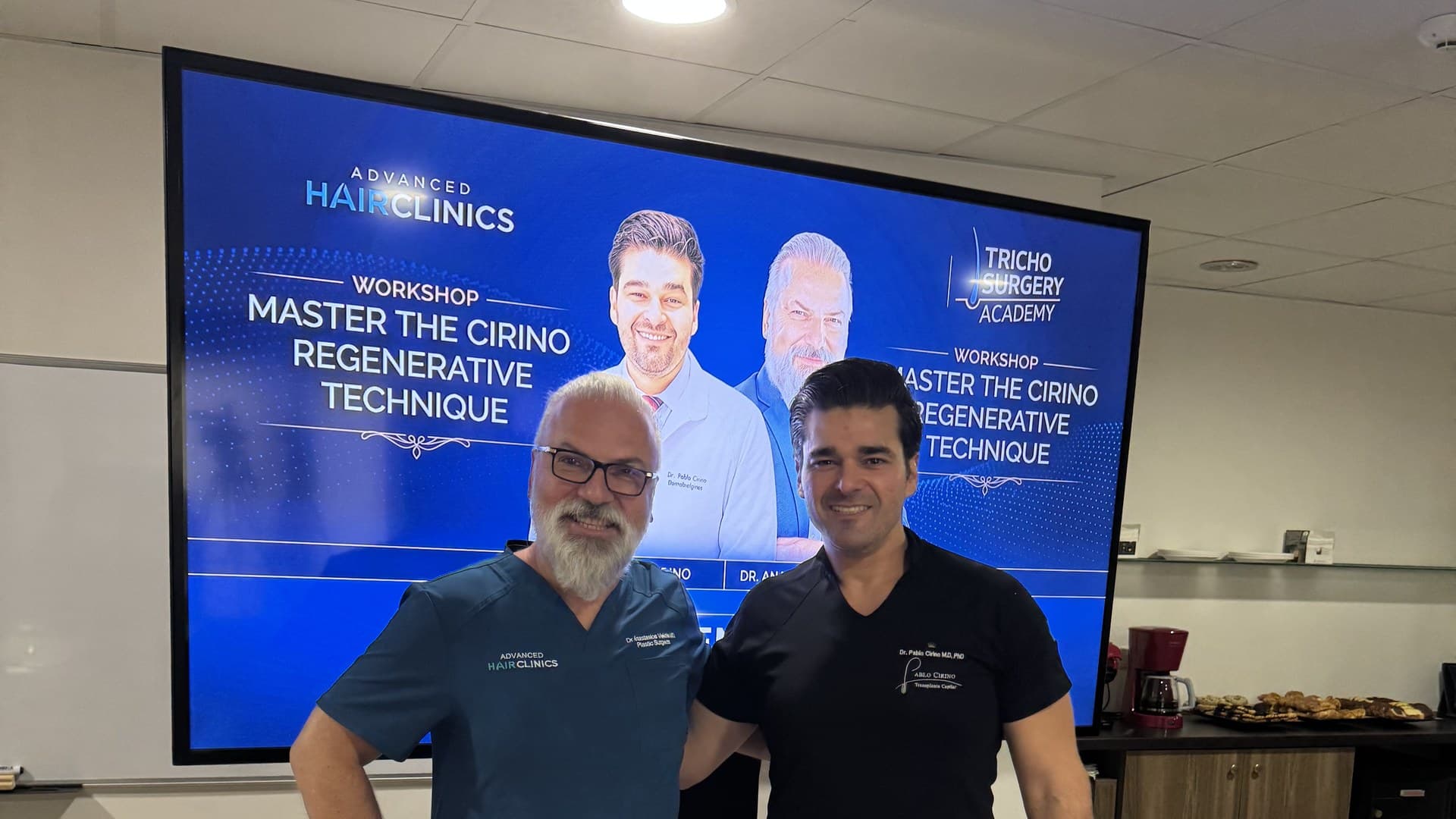
Cirino Regenerative Technique and AlopeciAI: what was presented at the Advanced Hair Clinics workshop
Does a patient who asks for a transplant always need one? And can someone see, from the very first assessment, where their hair loss may be heading over the coming years? The workshop held on 8 September by Advanced Hair Clinics revolved around these two questions.
Dr. Pablo Cirino, a physician and researcher from Brazil, presented the technique he has developed and applied it to four patients in front of the participants. Plastic surgeon Dr. Anastasios Vekris presented AlopeciAI, an artificial intelligence tool for assessing hair loss that is still in development. The workshop was followed by professionals from the field both in the room and online, from various countries, creating a particularly interesting environment for the exchange of knowledge and clinical experience.
Before a transplant: the Cirino Regenerative Technique (CRT™)
Dr. Cirino (MD, PhD) has developed the Cirino Regenerative Technique, which he originally called the Combined Regenerative Technique and has presented internationally. It is a minimally invasive microinjection technique through which therapeutic agents are applied directly to the scalp, at the level of the hair follicles.
CRT™ is not proposed as a replacement for hair transplantation. In selected patients it can come first, with the aim of preserving the hair that is already there and, where feasible, improving its appearance. The approach rests first on making use of the patient’s existing follicular potential. If a transplant is needed later, the two treatments can be combined.
Dr. Cirino has been using the technique for around ten years and, according to his clinic’s records, has treated approximately 10,000 patients with it. At the workshop he said that around 40% of those who had initially come for a hair transplant ultimately did not need one after CRT™ was applied. These are figures from his own practice and not a result that can be generalized to every patient.
Among the cases he showed, those involving patients with a previous transplant stood out — patients who had not been satisfied with the density or the overall appearance. Some arrived at his practice convinced they needed a second procedure. Some had begun to believe that their own hair was at fault, because the result of the first procedure had been, in his words, “poor.” For some of these patients he proposed CRT™ first. There were patients who ultimately did not need a second transplant and were satisfied with the result.
CRT™ in practice: four applications on patients
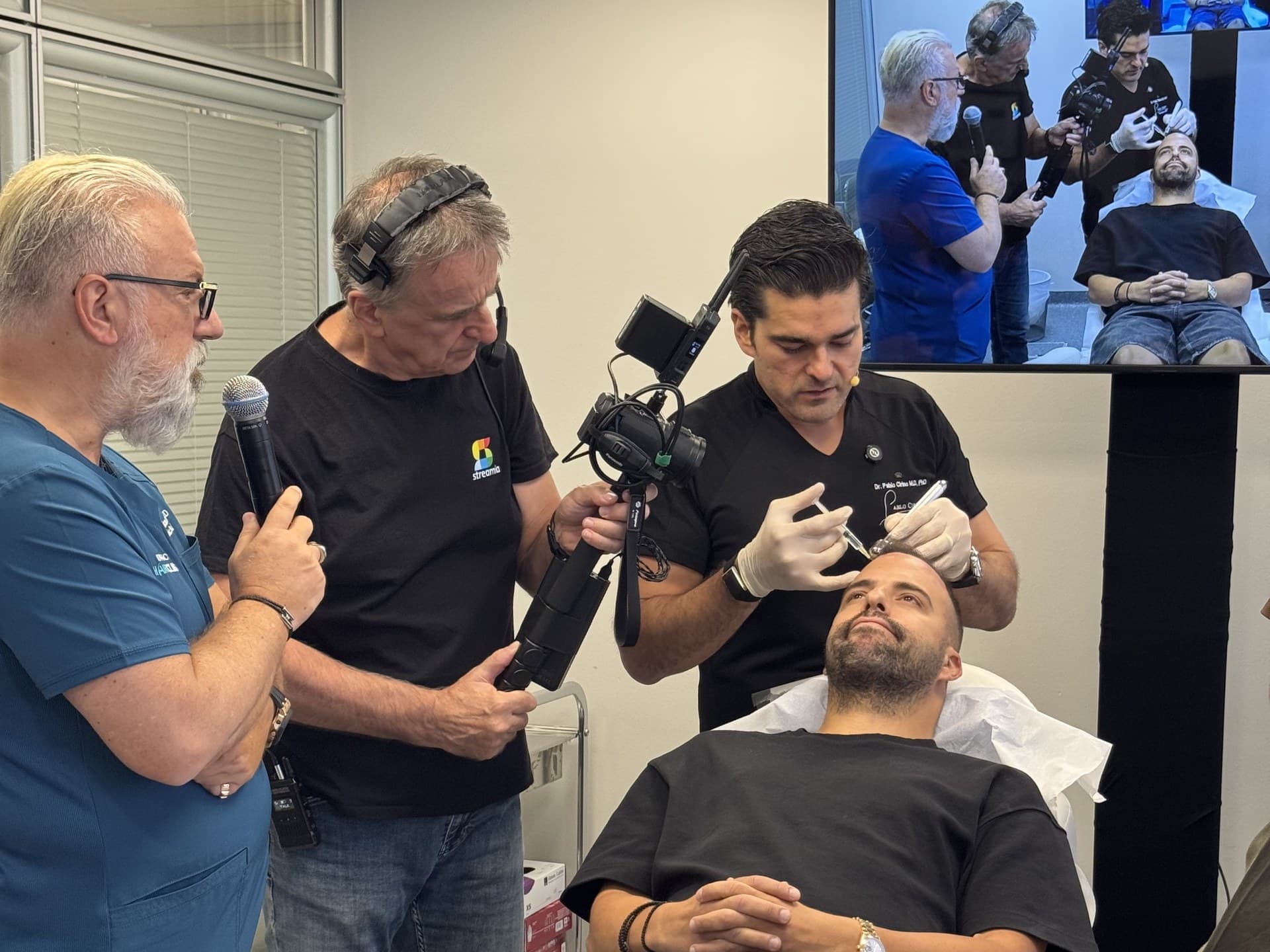
The practical part added something a presentation cannot give: the chance to see the technique applied in real conditions. Dr. Cirino performed CRT™ on four patients, three men and one woman, and the participants followed every stage at close hand. He answered questions as he worked and explained where particular care is needed, as well as how he adapts the procedure to each patient’s characteristics.
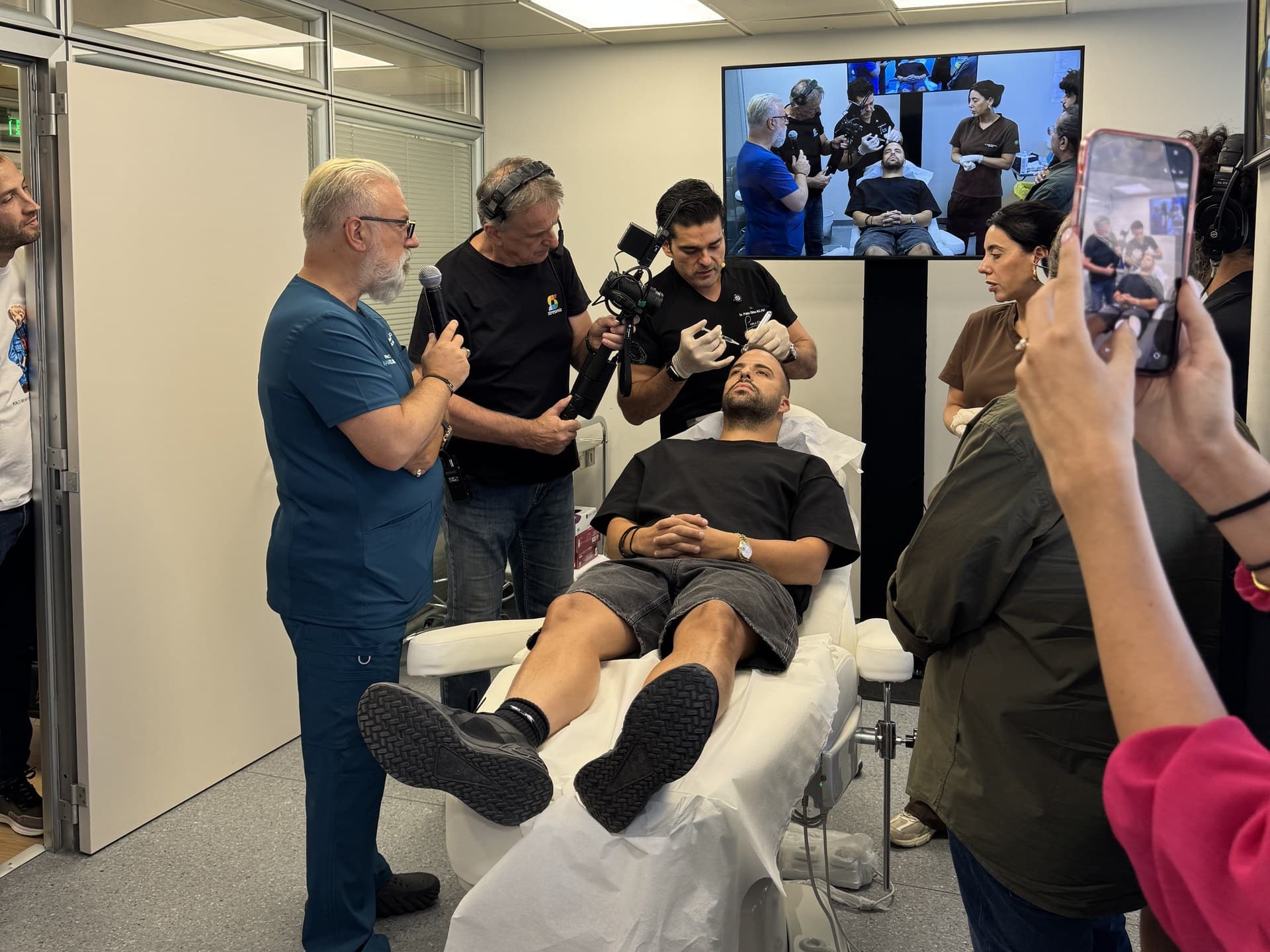
All four applications were completed smoothly, in line with the protocol that had been presented, and the patients said they were satisfied with their experience.
What the cases show and what the technique does not promise
In the before-and-after photographs and videos Dr. Cirino presented, the changes were not confined to density. In a number of patients, according to him, there was improvement in the quality and appearance of the hair as well. In some photographs, gray hairs even appeared darker later on. He was clear that this is not an aim of the treatment and that he cannot promise it.
He also dwelt on something that is often lost when results are discussed: not all patients respond in the same way. Age, the extent of the thinning, the condition of the hair follicles and each person’s history affect what they can realistically expect. That is why every case is assessed separately, before deciding whether the patient can benefit from CRT™.
Tolerability and side effects
Questions about the safety of the technique were also raised from the floor. Asked about allergic reactions, Dr. Cirino answered that he has not encountered any to date. The most pronounced discomfort he has seen is mild pain or tenderness in the head for two to three days. Some patients may also feel transient dizziness, which he associates most likely with the anesthetic. These symptoms subside and are managed with simple painkillers.
All of this describes one doctor’s experience with his own patients. It is not a guarantee of how any individual will respond, and medical assessment before any treatment remains essential.
Questions from the floor: red light and nutrition
Two of the questions raised concerned what happens outside the clinic. Asked about red light therapy, Dr. Cirino answered that he recommends it as a complementary measure for patients who have the time to apply it consistently at home. In a further question on the role of nutrition, he said that he works with nutritionists, to whom he refers patients for a program adapted to their needs, with options such as pumpkin seed oil. CRT™, as emerged from his answers, was not presented as a standalone solution.
AlopeciAI: an estimate of how hair loss may progress
Dr. Anastasios Vekris began from an observation drawn from everyday practice: many patients turn to a doctor once the thinning is already visible and the hair loss has progressed. An earlier assessment can give the doctor the opportunity to understand the situation better, to monitor how it develops and to discuss the options with the patient.
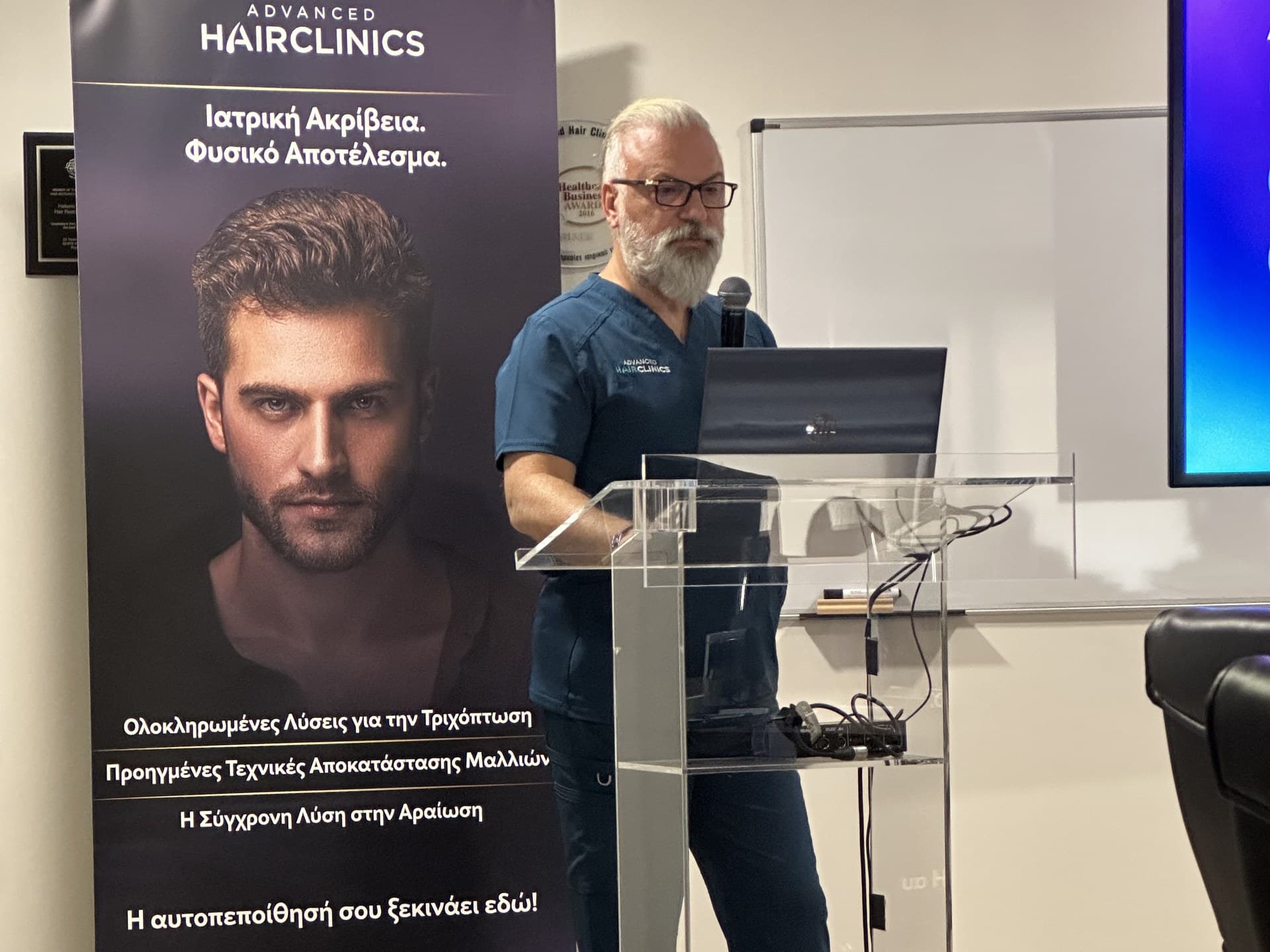
This is precisely what AlopeciAI is aimed at, a tool currently in development and expected to be released soon. Working from photographs of the patient, it produces an estimate of how hair loss may progress over the coming years.
The application guides the user, in a way reminiscent of face recognition on mobile phones, so that the photograph is taken from the correct position and distance. The system then takes measurements and compares the image with similar cases from its database, taking into account age, the characteristics of the face and the hair, hair color and, where information is available, family history. The doctor can also add clinical information, such as the stage of androgenetic alopecia on the Norwood scale.
Within a few seconds, a simulation appears alongside the current image showing how the same person may look in approximately 5 or 10 years. The patient therefore does not simply see their present face with less hair, but an estimate of their overall appearance. In theory the horizon could extend to 20 or 25 years, but the further the estimate moves from today, the greater the uncertainty. That is why the tool focuses on 5 to 10 years, a period that is more realistic and more readily understood by the patient.
The database already includes hundreds of cases and will be enriched with new ones. As it grows, the system will have more comparable cases available for each estimate. In every instance, what the patient sees is a possible progression and not a certain prediction.
A tool for the conversation between doctor and patient
Beyond the estimate, AlopeciAI has been designed to help inform the patient. Complex medical information becomes something they can see with their own eyes: where they stand today, how the hair loss may progress if it is not addressed, what treatment options exist and what they can realistically expect from each one.
The platform can also bring together the assessment data, the treatments and the appointments, support video calls for monitoring the patient and, depending on the functions each clinic chooses to incorporate, present available treatment options or products.

AlopeciAI has also been designed as a white-label platform, meaning it can be used by other clinics under their own brand name, adding their own cases to the database.
AlopeciAI does not replace medical assessment, nor does it decide on treatment. The final choice belongs to the doctor, after clinical examination and discussion with the patient.
What the two presentations had in common

The two presentations moved in different fields, one around a therapeutic technique and the other around a digital tool. They arrived, however, at a common idea: timely and meaningful information can give the patient more options before any decision is made. Dr. Cirino showed how, in selected patients, the effort to preserve existing hair can precede the surgical solution. Dr. Vekris showed how technology can help someone understand what may happen, before the thinning progresses.
For anyone noticing thinning, then, the first step is not choosing a treatment but a proper assessment by a specialist.
Book an Appointment with Our Medical Team
Book an appointment at ADVANCED HAIR CLINICS for a diagnosis and find answers to your questions about hair transplantation.
Contact Form