

What is the ideal age for a hair transplant
Age is often a concern for those considering a hair transplant. Many wonder if it’s ‘too early’, whilst others fear it may be ‘too late’. In practice, there is no ‘ideal age’ in the strict sense, but rather the right time. Age alone does not determine whether someone is a suitable candidate. More important are the stability of hair loss, the quality of the donor area, overall health, and realistic expectations.
Clinical experience shows that excellent results can be achieved across different age groups, provided an informed decision is made and long-term surgical planning is undertaken.
Why age plays a role in hair transplantation
Hair transplantation involves transplanting hair follicles that are resistant to the effects of the DHT hormone, which is responsible for androgenetic alopecia. However, the natural hair surrounding the transplanted follicles may continue to thin and fall out. When hair loss is still progressing, the aesthetic result can gradually change over time.
For this reason, assessing the progression pattern of alopecia is more important than the patient’s age.
Consequently, age affects hair transplantation indirectly—not because of the number of years, but because it correlates with the progression of androgenetic alopecia. In younger individuals, hair loss is often still advancing and may continue for many years. This makes precise hairline planning more difficult and increases the risk of future asymmetries in density, as the surrounding hair continues to thin.
Conversely, the pattern of hair loss in older patients is usually more predictable, allowing for more effective planning. At the same time, age also affects other parameters such as skin elasticity, microcirculation, and healing rate. Whilst these factors do not preclude transplantation at a more advanced age, they are taken into account during planning to ensure a natural appearance and long-term maintenance of results.
Evolution of hair loss by age
The likelihood of advanced hair loss increases markedly with age. According to an epidemiological study of men aged 18 to 49 years, approximately 42% exhibited moderate to extensive hair loss (Norwood stage III or higher).
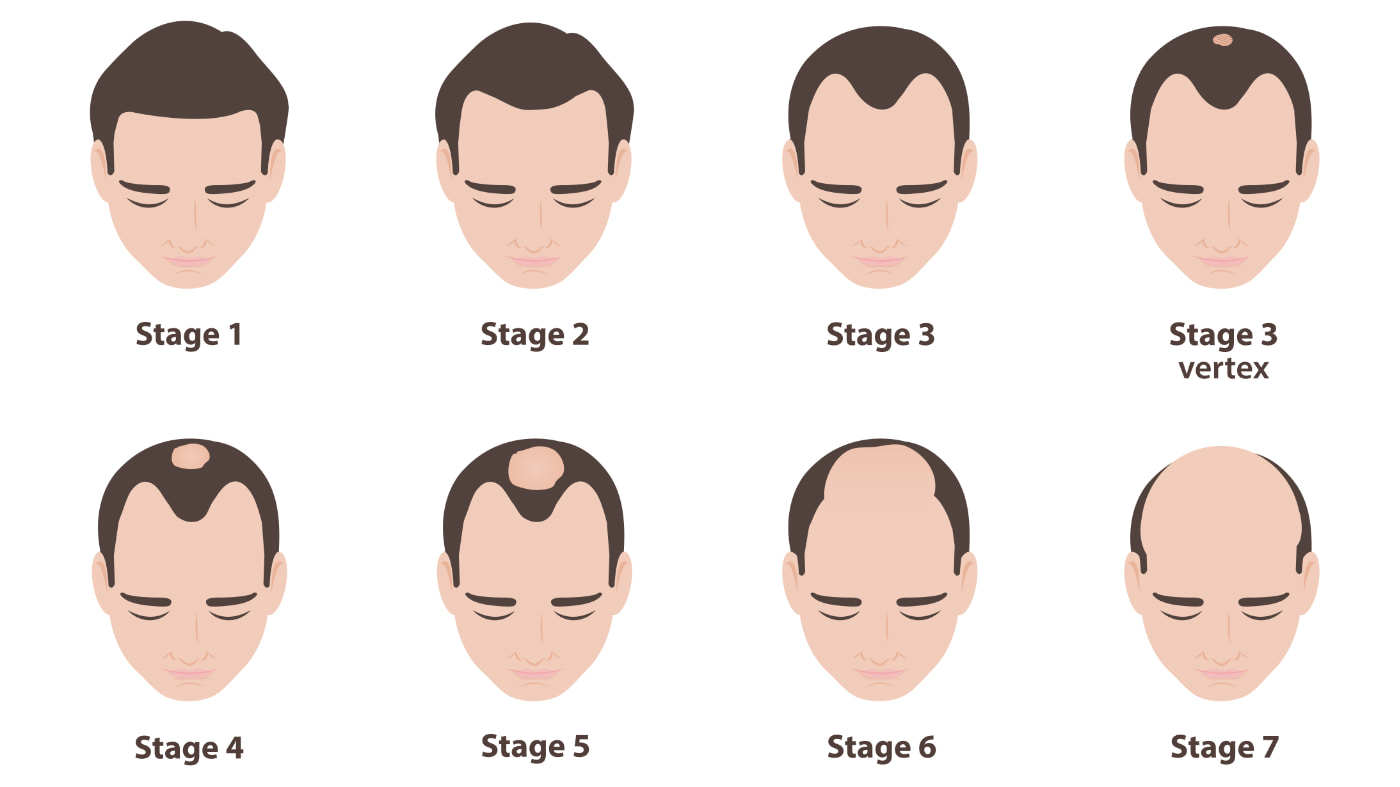
More specifically:
- 16% of men aged 18–29 years showed stage III or higher
- 53% of men aged 40–49 years exhibited comparable levels of hair loss
- 12% displayed thinning primarily in the frontal scalp area
Differences by gender and age
Scientific research from the ISHRS shows notable differences in demand for hair transplants by age and gender. Men aged 30–49 years constitute the largest patient group, whilst among women the procedure is more commonly performed at an older age, when the thinning pattern has stabilised. This demonstrates that the decision to undergo a transplant relates not only to age, but also to the type and stability of hair loss.
Under 25 years
For individuals under 25 years, hair transplantation is rarely the first choice. At this stage, the hairline and pattern of hair loss have often not yet stabilised. Even with visible recession at the temples or thinning at the front, predicting future development is difficult.
An early surgical intervention can deplete valuable grafts from the donor area that may be needed later. For this reason, most specialists initially recommend a conservative approach, such as medical treatment with minoxidil, finasteride, or autologous PRP mesotherapy, as well as monitoring.
However, there are certain exceptions. When hair loss is due to trauma, burns, or post-surgical scarring of the scalp, a hair transplant may be considered even at age 18. In these cases, the hair loss is localised and does not follow a progressive course.
25 to 45 years
For many patients, the period between 25 and 45 years is considered the most favourable time for a hair transplant. In this age group, hair loss has often slowed or stabilised, whilst the quality of the donor area generally remains good.
Research demonstrates that outstanding results can be achieved at this age, combining a natural appearance with long-term retention, provided the planning accounts for likely future thinning rather than just the current presentation.
After 50 years
An age above 50 years is not a contraindication for hair transplantation. On the contrary, many studies and clinical observations show that men at this age often have particularly realistic expectations and high satisfaction with results.
In these cases, the goal is not to restore a youthful hairline, but rather to achieve an aesthetic improvement that reduces the appearance of alopecia and provides a more balanced look. Good overall health and an adequate donor area are the decisive success factors.
Discover when the right time for a hair transplant is
There is no single ‘ideal age’ that applies to everyone. Excellent results can be achieved at any age, provided the right conditions are in place.
The right time for a hair transplant emerges from a combination of factors:
- stable pattern of hair loss
- adequate and healthy donor area
- good overall health
- realistic aesthetic goals
A consultation with a specialised hair transplant surgeon is essential so that all these factors can be assessed and a suitable solution developed that remains natural and effective over time.
Contact Advanced Hair Clinics for a diagnostic assessment and personalised treatment options tailored to your needs. Call from Greece on (+30) 210 6980451 and from Cyprus on (+357) 25251040, or leave your message below and we will get back to you as soon as possible.
Book an Appointment with Our Medical Team
Book an appointment at ADVANCED HAIR CLINICS for a diagnosis and find answers to your questions about hair transplantation.
Contact Form